Businessman highlighting real estate investment mistakes with a declining graph.
7 Villa Investment Mistakes That Cost Buyers $50K+ (And How to Avoid Them)
In this article10 sections
- 7 Villa Investment Mistakes That Cost Buyers $50,000 or More
- Mistake 1: Skipping Due Diligence on the Developer
- Mistake 2: Choosing the Wrong Location
- Mistake 3: Ignoring Rental Management (or Managing It Yourself)
- Mistake 4: Getting the Legal Structure Wrong
- Mistake 5: Believing Unrealistic Return Promises
- Mistake 6: Ignoring Construction Quality
- Mistake 7: Ignoring Seasonality in Your Financial Model
- The Common Thread: Professional Management and Developer Quality
- Frequently Asked Questions

7 Villa Investment Mistakes That Cost Buyers $50,000 or More
After building and managing 50+ luxury pool villas across Phuket, Koh Samui, Bali, Mykonos, and Ibiza, SKHAI has seen every mistake a property investor can make. Some cost time. Most cost money. A few cost both — in amounts that would have funded an entire second investment if allocated correctly.
The seven mistakes below are drawn from real situations we have witnessed in the Thai villa market. For each one, we explain what goes wrong, what it costs, and what to do instead.
Mistake 1: Skipping Due Diligence on the Developer
What it costs: $50,000 to total loss of investment
The single most expensive mistake in off-plan villa investment is failing to verify the developer’s track record. Thailand’s property boom has attracted developers with zero construction experience, inadequate capitalization, and in some cases, no intention of completing the project.
What goes wrong
- Developer runs out of funding mid-construction. Your deposit and milestone payments are unrecoverable if not held in escrow.
- Construction quality is poor — structural defects, water infiltration, electrical issues — requiring $30,000-$80,000 in remediation within the first 2-3 years.
- Developer has no completed projects. Slick marketing materials and model units do not equal construction capability.
- Building permits are not properly issued. The villa may face enforcement action or cannot be legally occupied.
What to do instead
- Visit completed projects. Any developer with a track record will happily arrange site visits. If they have no completed projects, your risk profile changes dramatically.
- Speak to existing owners. Ask for references and contact them directly. Ask about build quality, timeline accuracy, communication, and post-handover support.
- Verify permits and titles independently. Engage your own lawyer to confirm the developer holds valid construction permits and clear land title (Chanote).
- Check financial standing. Is the developer self-funded, bank-financed, or dependent on pre-sales? Understanding the financial structure tells you how vulnerable the project is to market slowdowns.
SKHAI’s approach: We invite every prospective buyer to visit our completed developments in Phuket and Koh Samui, inspect build quality firsthand, and speak to existing owners. We actively encourage independent legal review. If a developer discourages these steps, that tells you everything you need to know.
Mistake 2: Choosing the Wrong Location
What it costs: 30-50% of potential rental income, permanently
A beautiful villa in the wrong location is a lifestyle asset, not an investment. Location determines rental demand, occupancy rates, nightly rates, and ultimately — yield. The wrong location can mean the difference between 8.4% net yield and 3% net yield on an identical villa.
What goes wrong
- Investor buys based on price alone — cheapest villa, inland location, no proximity to beaches or amenities. Tourists do not book inland villas at premium rates.
- Beautiful sea view but 45 minutes from the airport and 30 minutes from restaurants. Guests leave negative reviews about isolation.
- Developer sells in an “up and coming area” that never comes up. Without established tourism infrastructure, rental demand remains weak.
What to do instead
- Follow the rental data. Choose locations with demonstrated occupancy and ADR performance. In Phuket, the Bangtao-Cherngtalay-Layan corridor delivers the strongest rental metrics. In Koh Samui, Chaweng Noi and Lamai lead. Read our area-by-area Phuket analysis.
- Prioritize proximity to demand drivers: beaches (under 15 minutes), restaurants, beach clubs, and airport access.
- Verify the rental market exists. Check Airbnb and Booking.com for comparable listings in the area. If there are few listings and low review counts, the rental market is unproven.
SKHAI locates all developments in zones with demonstrated rental demand. Our Phuket properties (Sunrise Garden, Sunrise Palms, Sunrise Valley) are in the Bangtao-Cherngtalay-Pasak corridor — Phuket’s strongest rental zone, delivering 7.8-8.4% net yield at 72-78% occupancy.
Mistake 3: Ignoring Rental Management (or Managing It Yourself)
What it costs: $15,000-$25,000 per year in lost revenue
A luxury pool villa is a hospitality business. It requires dynamic pricing, multi-platform distribution, guest communication, housekeeping, maintenance, and review management. Investors who try to manage remotely — or hire a friend, a neighbor, or a part-time caretaker — consistently underperform professionally managed properties by 30-50% in annual revenue.
What goes wrong
- Fixed pricing instead of dynamic pricing. A villa listed at $200/night year-round leaves $50,000+ on the table during peak season (when rates should be $350-$500) and sits empty during low season (when $120-$150 would fill it).
- Single-platform listing. Only on Airbnb? You are missing Booking.com (40%+ of European bookings), Agoda (dominant in Asia), and direct booking channels that avoid 15-20% platform commissions.
- Poor guest experience. Slow response times, dirty pools, broken appliances — each issue generates a negative review that suppresses future bookings for months.
- Deferred maintenance. Small problems become expensive problems. A $200 plumbing fix becomes a $5,000 water damage repair.
What to do instead
- Budget for professional management from day one. Standard management fees are 20-30% of gross rental income. This is not a cost — it is a revenue multiplier. A professionally managed villa at 78% occupancy generates far more net income than a self-managed villa at 45% occupancy, even after fees.
- Choose developer-managed if possible. A developer who built the villa understands its systems, specifications, and maintenance requirements. SKHAI’s STAYLAR management service is built on this principle.
- Demand transparency. Monthly revenue reports, expense breakdowns, occupancy data, and guest review scores should be standard. If your manager cannot or will not provide these, find one who will.
Mistake 4: Getting the Legal Structure Wrong
What it costs: $50,000+ in legal fees, potential total loss of property rights
Foreign ownership of land in Thailand is restricted by the Land Code. Legal structures exist to give foreigners practical control of villa properties — but the wrong structure can leave your investment legally vulnerable.
What goes wrong
- Nominee company structures. A Thai company where Thai “shareholders” hold shares on the foreigner’s behalf to circumvent land ownership restrictions. This is illegal under Thai law and subject to active enforcement by the Department of Special Investigation. Properties held through nominee structures can be seized.
- Unregistered leases. A lease agreement that is not registered at the Land Department has no legal standing. If the landlord sells the land, the new owner is not bound by your unregistered lease.
- Relying on developer-drafted contracts without independent review. The developer’s lawyer works for the developer. You need your own.
What to do instead
- Use a registered 30-year leasehold — the standard, legal, and enforceable structure for foreign villa ownership in Thailand.
- Engage independent legal counsel. A Thai law firm that does NOT work for the developer. Budget $1,430-$4,300 (50,000-150,000 THB) for contract review and due diligence — a fraction of what a legal error costs.
- Verify everything independently: land title (Chanote), construction permits, lease registration, and company structure (if applicable).
- Read our full ownership structure guide before committing to any legal arrangement.
Mistake 5: Believing Unrealistic Return Promises
What it costs: The difference between expected and actual returns — typically $10,000-$30,000 per year
When a developer promises “guaranteed 15% annual returns” or “25-30% ROI,” ask one question: where does the money come from? If the answer is not a detailed, verifiable breakdown of rental income, occupancy data, and operating costs — the promise is likely subsidized from your purchase price or simply fabricated.
What goes wrong
- “Guaranteed rental returns” funded from the purchase price. The developer inflates the villa price by 15-20% and returns the excess over 2-3 years as “guaranteed rental income.” You are paying yourself.
- Gross yields presented as net yields. A developer quotes “12% rental yield” — but that is gross, before 25-30% management fees, platform commissions, maintenance, insurance, and operating costs. Net yield is 7-8%. The 4-5% gap is real money.
- Projections based on 95% occupancy. No villa achieves 95% occupancy year-round. Professional management in prime locations achieves 68-78% (based on STAYLAR data). Marketing projections at 90%+ occupancy are fantasy.
What to do instead
- Demand net yield data — after all operating costs, management fees, and platform commissions.
- Ask for audited performance data from existing properties. If a developer has completed projects, they should be able to share actual (not projected) rental performance. SKHAI publishes portfolio data: 7.2-8.4% net yield across 6 developments, 68-78% occupancy.
- Build your own model. Research comparable nightly rates on Airbnb/Booking.com, assume 65-75% occupancy, deduct 25-30% for management and 10-15% for operating costs. If the developer’s numbers look significantly better than your independent calculation, ask why.
- See our data-backed analysis of realistic villa returns.
Mistake 6: Ignoring Construction Quality
What it costs: $20,000-$80,000 in repairs within the first 5 years
Thailand’s tropical climate — heat, humidity, monsoon rain, and salt air (on coastal properties) — is brutal on buildings. Construction quality that would be adequate in temperate climates fails quickly in tropical conditions. Cheap materials and poor workmanship accelerate this process dramatically.
What goes wrong
- Waterproofing failures. Inadequate waterproofing on flat roofs, around pool edges, and in bathrooms leads to water infiltration, mold, and structural damage. This is the most expensive and most common defect in tropical construction.
- Substandard electrical work. Improper grounding, undersized wiring, and non-compliant installations create safety hazards and require complete rewiring ($10,000-$30,000).
- Poor material selection. Cheap tiles crack. Budget hardware corrodes. Thin-gauge steel rusts. Low-quality pool systems fail. Every component that fails requires guest displacement and repair costs.
- Foundation issues. Phuket and Samui have varied soil conditions. Without proper geotechnical assessment and appropriate foundation design, settlement cracks and structural movement can appear within 2-3 years.
What to do instead
- Inspect the developer’s completed projects — not showrooms or model units. Look at properties that are 2-5 years old. How have they aged?
- Ask about specifications. What grade of concrete? What type of waterproofing system? What brand of pool equipment? A quality developer will answer these questions in detail.
- Hire an independent surveyor for pre-purchase inspection (completed properties) or milestone inspections (off-plan).
- Understand warranty coverage. What defects are covered, for how long, and what is the claims process?
SKHAI provides structural warranties and a defect liability period on all developments. We build with the understanding that our reputation — and our management company’s operational efficiency — depends on construction quality lasting decades, not years.
Mistake 7: Ignoring Seasonality in Your Financial Model
What it costs: Cash flow stress, forced sales, missed opportunities
Thailand’s villa rental market is seasonal. If your financial model assumes uniform monthly income, you will experience cash flow stress during low season — and potentially make poor decisions as a result.
What goes wrong
- Investor budgets based on average monthly income ($4,000/month from $48,000 annual net). In reality, December-February generates $8,000-$12,000/month while June-September generates $1,500-$2,500/month. If expenses are fixed at $3,000/month, low season produces cash flow shortfalls.
- Panic during first low season leads to fire-sale pricing, damaging the villa’s positioning and future booking rates.
- No reserve fund for maintenance during low season, when many repairs and upgrades should be scheduled.
What to do instead
- Model seasonally. Use the STAYLAR seasonal distribution: peak season (Dec-Feb) = ~35% of annual revenue, high shoulder (Nov, Mar-Apr) = ~25%, low shoulder (May, Oct) = ~15%, low season (Jun-Sep) = ~25%.
- Maintain a cash reserve. Hold 3-6 months of operating costs in reserve to cover low-season shortfalls without distress decisions.
- Schedule maintenance during low season. Pool resurfacing, repainting, appliance replacements — plan these for June-September when the villa would otherwise sit partially empty.
- Consider Koh Samui for smoother cash flow. Samui’s dual-peak season (Dec-Feb + Jul-Aug) provides more evenly distributed revenue than single-peak markets. See Koh Samui investment data.
The Common Thread: Professional Management and Developer Quality
Five of the seven mistakes above — location, management, return expectations, construction quality, and seasonality — are eliminated or substantially reduced by choosing the right developer and professional management from the outset.
SKHAI operates as a vertically integrated developer: we build and manage our villas through STAYLAR. Our current portfolio performance across 6 developments in 3 destinations:
| Development | Net Yield | Occupancy |
|---|---|---|
| Sunrise Garden Phuket | 8.4% | 78% |
| Sunrise Palms Phuket | 8.1% | 74% |
| Sunrise Valley Phuket | 7.8% | 72% |
| Coral Cove Koh Samui | 7.5% | 70% |
| Sunrise Residences Koh Samui | 7.2% | 68% |
| Core Villas Bali | 8.0% | 72% |
These returns are the product of getting the fundamentals right: prime locations, quality construction, and professional hospitality management from day one.
Frequently Asked Questions
What is the biggest risk in Thai villa investment?
Developer failure on off-plan projects (Mistake 1) and nominee company structures (Mistake 4) carry the highest financial risk — both can result in total loss of investment. Proper due diligence and independent legal review are your primary defenses.
How do I verify a developer’s track record?
Visit completed projects (not showrooms), speak to existing owners, verify construction permits and land titles through independent legal counsel, and check the developer’s corporate registration and financial standing.
What net yield should I realistically expect?
In professionally managed prime locations: 7-8.5% net yield. SKHAI’s portfolio delivers 7.2-8.4% across 6 developments. Any promise above 10% net warrants deep scrutiny — ask for audited performance data, not projections.
Should I manage my villa myself?
No — unless you live on the island, have hospitality experience, and are prepared to treat it as a full-time job. Professional management at 20-30% of gross revenue consistently outperforms self-management by 30-50% in total net income. Learn about STAYLAR’s approach.
What legal structure should I use?
A registered 30-year leasehold is the standard, legal, and enforceable structure for foreign villa ownership. Avoid nominee company structures (illegal) and unregistered leases (unenforceable). Engage independent legal counsel — budget $1,430-$4,300. Read our ownership guide.
How do I avoid overpaying for a villa?
Research comparable properties on listing platforms. Understand the price-per-sqm range in your target area. Compare off-plan pricing (15-25% discount) with completed properties. And always assess value based on net yield potential, not just purchase price.
What should I budget for annual maintenance?
1-2% of property value annually for maintenance reserves, plus CAM fees ($115-$285/month), insurance ($430-$1,145/year), and utilities during vacant periods. A quality-built villa from an established developer will cost less to maintain than a budget construction. See our full cost breakdown.
Start your villa investment on the right footing. Explore SKHAI’s investment guide for data-driven analysis across Phuket, Koh Samui, and Bali, or speak with our investment team to discuss your objectives.
Based on SKHAI’s experience building and managing 50+ luxury pool villas across 5 international destinations. Last updated: March 2026.
Stay informed
Curated luxury real estate insights — direct to your inbox.
Ready to Invest?
Explore our investment guides for Phuket, Koh Samui, and Bali — ownership, yields, and pricing.
View Investment GuidesStay Informed
Luxury real estate insights — delivered to your inbox.
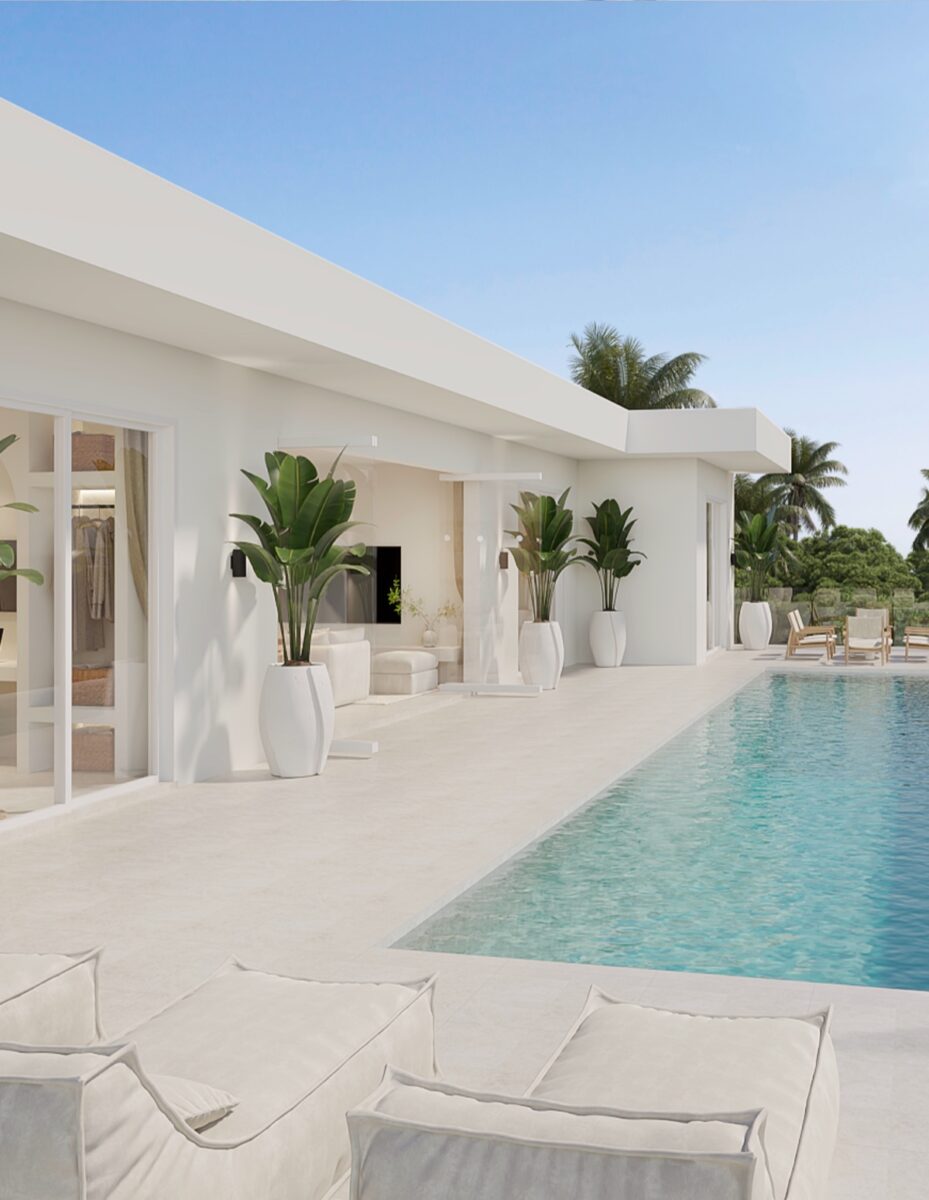
Sunrise Hills Koh Samui
Panoramic hillside villas in Koh Samui — contemporary luxury with ocean views.
View Development →from a Decade
in Real Estate SKHAI
10 Lessons from a Decade in Luxury Real Estate
What we’ve learned building villas across top global destinations — from due diligence to maximising rental returns.
Read the Free Guide →STAY INFORMED
Luxury living, smart investing
Curated insights on real estate investment across Phuket, Koh Samui & Bali. Direct from the developer.
Free guide sent to your inbox. No spam.