Off-Plan vs Completed Villa: Which Delivers Better ROI? (With Real Numbers)
In this article12 sections
- The Investment Case for Off-Plan Villas
- Understanding the Off-Plan Price Advantage
- Payment Structure: The Cash Flow Advantage
- Capital Appreciation During Construction
- Off-Plan vs Completed Villa: Direct Comparison
- The Rental Yield Equation
- Risk Considerations and How to Mitigate Them
- Ownership Structures: Thailand and Bali
- When Completed Villas Make Sense
- A Five-Year Return Model
- Market Timing and Current Conditions
- The Numbers Speak Clearly
The Investment Case for Off-Plan Villas
For international buyers evaluating luxury villa investments in Southeast Asia, few decisions carry as much financial consequence as timing. Specifically: should you purchase an off-plan villa during the development phase, or acquire a completed property ready for immediate use?
The data overwhelmingly favours off-plan acquisition. Across Thailand’s established villa markets in Phuket and Koh Samui, and Indonesia’s high-growth Bali corridor, buyers who enter during the construction phase consistently achieve superior returns through a combination of below-market entry pricing, capital appreciation during the build period, and structured payment plans that optimise cash deployment.
This analysis examines the real numbers behind both approaches — drawing on verified transaction data from active villa developments — to quantify exactly where the return differential lies.
Understanding the Off-Plan Price Advantage
Off-plan villas are priced below their eventual market value for a straightforward reason: developers offer early-phase discounts to secure capital before construction begins. This is not charity — it is a financing mechanism that benefits both parties. The developer gains working capital and pre-sales that satisfy construction lenders. The buyer gains a price advantage that, in most Southeast Asian markets, ranges between 20% and 30% below the villa’s completed market value.
How the discount compounds
Consider a pool villa in Phuket’s Bangtao corridor with a completed market value of THB 15 million (approximately USD 430,000). An off-plan buyer entering at launch phase typically secures this villa for THB 11.25 million to THB 12 million — a discount of THB 3 million to THB 3.75 million before any market appreciation is factored in.
During the 18 to 24-month construction period, the surrounding market does not stand still. Phuket’s west coast villa segment has recorded annual price appreciation of 8% to 12% over the past five years, driven by constrained land supply, sustained tourism growth exceeding 14 million annual visitors, and continued infrastructure investment. By completion, the villa’s market reference price may have moved from THB 15 million to THB 16.5 million or higher — widening the buyer’s effective gain.
The compounding effect in numbers
- Entry price (off-plan, Phase 1): THB 11.5 million
- Market value at launch: THB 15 million
- Market value at completion (24 months, 9% annual growth): THB 17.8 million
- Total unrealised gain at handover: THB 6.3 million (55% on capital deployed)
A completed villa purchased at THB 15 million on the same day would deliver only the market appreciation component — approximately THB 2.8 million over the same period, and that on 100% of capital deployed upfront rather than staged instalments.
Payment Structure: The Cash Flow Advantage
Perhaps the most underappreciated advantage of off-plan purchase is the payment schedule. While a completed villa demands full settlement at exchange — whether through cash reserves or mortgage financing — off-plan purchases distribute capital outlay across the entire construction timeline.
Typical off-plan payment structure (Thailand)
- Reservation deposit: 5% to 10% at contract signing
- Construction milestone payments: 30% to 40% distributed across foundation, structure, and fit-out stages
- Completion payment: 50% to 60% at handover and title transfer
This structure means the buyer’s capital remains productive elsewhere — in equities, fixed income, or other property holdings — for the majority of the construction period. On a THB 12 million off-plan villa, the initial outlay might be THB 1.2 million, with subsequent payments of THB 1.8 million at quarterly milestones. Full capital commitment occurs only at handover, by which point the asset has already appreciated significantly.
Opportunity cost comparison
An investor purchasing a completed villa at THB 15 million must deploy the entire sum immediately. Assuming even a conservative 5% annual return on the capital that an off-plan buyer keeps invested elsewhere during the 20-month build period, the opportunity cost of the completed purchase adds approximately THB 1.25 million in foregone returns. This figure alone narrows any perceived convenience premium of buying completed.
Capital Appreciation During Construction
Off-plan villas appreciate in two distinct ways during the development phase, and understanding both is essential to evaluating the full return profile.
1. Development-stage price escalation
Well-managed developers implement phased pricing: each construction milestone triggers a price increase for remaining unsold units. A villa purchased at foundation stage for THB 11.5 million may be listed at THB 13 million once the roof is on and THB 14.5 million when fit-out begins. Early buyers benefit from this systematic repricing without additional capital deployment.
2. Market-wide appreciation
Independently of developer pricing strategy, the broader market moves. In Bali’s Canggu and Uluwatu corridors, land values increased 15% to 20% annually between 2023 and 2025. Koh Samui’s northeast coast recorded 10% to 14% annual villa price growth over the same period. These macro movements lift the value of all properties — but off-plan buyers locked their entry price months or years earlier.
Combined, these two vectors can deliver 7% to 12% annualised capital growth during the construction phase alone — before any rental income enters the equation.
Off-Plan vs Completed Villa: Direct Comparison
| Metric | Off-Plan Villa | Completed Villa |
|---|---|---|
| Entry price vs market value | 20–30% below completed value | Full market price |
| Capital required at signing | 5–10% deposit | 100% (cash or mortgage) |
| Payment timeline | Staged over 18–24 months | Immediate full settlement |
| Capital appreciation (build period) | 7–12% annually on full asset value | Same market rate, but on higher cost basis |
| Customisation | Full specification control (layouts, finishes, pools) | Accept existing specification or renovate at cost |
| Rental income start | 18–24 months after purchase | Immediate (if turnkey) |
| Warranty & condition | New build, full structural warranty | Varies; potential maintenance backlog |
| 5-year projected ROI (total return) | 65–95% (discount + appreciation + yield) | 35–55% (appreciation + yield only) |
| Developer risk | Present (mitigated by escrow, track record) | Minimal (asset exists) |
The Rental Yield Equation
Critics of off-plan investment often cite the delayed rental income as a disadvantage. This argument deserves examination — and ultimately fails under scrutiny when the full financial picture is considered.
Net rental yields in context
Well-managed pool villas in Phuket and Koh Samui — particularly those integrated into professional hospitality programmes — deliver 7% to 8% net annual yields after management fees, maintenance, and vacancy are deducted. Bali’s villa market achieves similar figures in prime locations like Canggu and Seminyak, though with higher seasonal variance.
On a THB 15 million completed villa, that translates to approximately THB 1.05 million to THB 1.2 million in annual net rental income. Over the 20-month construction period that an off-plan buyer waits, the foregone rental income totals approximately THB 1.75 million to THB 2 million.
But the maths still favours off-plan
Set this foregone rental income against the off-plan buyer’s advantages:
- Entry discount: THB 3 million to THB 3.75 million saved at purchase
- Capital appreciation during build: THB 1.5 million to THB 2.5 million
- Opportunity cost on retained capital: THB 750,000 to THB 1.25 million
- Minus foregone rent: -THB 1.75 million to -THB 2 million
Net advantage of off-plan at handover: THB 3.5 million to THB 5.5 million — equivalent to 3 to 5 years of rental income captured in a single transaction.
Risk Considerations and How to Mitigate Them
Off-plan investment is not without risk, and responsible analysis requires acknowledging this directly. The two primary concerns are developer default (failure to complete) and construction delays.
Developer due diligence
The mitigation is straightforward: buy from developers with verified completion track records, transparent escrow arrangements, and existing operational projects you can inspect. In Thailand, buyers should verify:
- Construction permits issued by local authorities
- Escrow accounts held with licensed Thai banks
- Previous project completion history (physically visit earlier developments)
- Company registration and financial standing
- Integration with an established rental management operator
Construction delays
Delays of 2 to 4 months are common in tropical construction markets and should be factored into financial modelling. However, delays beyond 6 months are rare with established developers and typically trigger contractual protections including penalty clauses or refund options. Thai consumer protection law provides additional recourse for foreign buyers purchasing condominium freehold units.
Market correction risk
Both off-plan and completed buyers face market correction risk equally. However, the off-plan buyer’s lower cost basis provides a significantly larger buffer against downside scenarios. A buyer who entered at a 25% discount can absorb a market correction of that magnitude before reaching breakeven — a scenario that would represent a substantial loss for the completed buyer.
Ownership Structures: Thailand and Bali
The off-plan vs completed decision is independent of ownership structure. Both routes offer identical legal frameworks for foreign buyers:
Thailand (Phuket and Koh Samui)
- Freehold condominium: Foreign buyers can hold full freehold title on condominium units (within the 49% foreign quota per project). Available for both off-plan and completed units.
- Leasehold villa: 30-year registered lease with contractual renewal options (30-year renewable structure). The standard vehicle for villa ownership by foreign nationals. Identical terms apply whether purchasing off-plan or completed.
Bali, Indonesia
- Leasehold (Hak Sewa): 25 to 30-year initial terms with renewal options. The predominant foreign ownership vehicle for villas.
- Right to Build (Hak Guna Bangunan): Available through Indonesian-incorporated entities (PT PMA) for larger investments.
In all cases, the legal protections, registration procedures, and enforcement mechanisms are identical regardless of whether the property is purchased off-plan or completed. The distinguishing factor is purely financial and strategic.
When Completed Villas Make Sense
Intellectual honesty requires acknowledging scenarios where a completed purchase may be appropriate:
- Immediate occupancy requirement: Buyers relocating within 3 months who need a primary residence cannot wait 18 to 24 months for construction.
- Zero risk tolerance: Investors who cannot accept any construction-phase uncertainty, regardless of the financial cost of that certainty.
- Distressed or below-market resale: Occasionally, completed villas appear at significant discounts due to seller circumstances. These are opportunistic and unpredictable.
- Cash flow dependency: Investors who require immediate rental income to service other obligations may prioritise speed over total return.
For the majority of international investors whose primary objective is wealth accumulation through Southeast Asian property — and who have an 18 to 24-month horizon before requiring income — off-plan acquisition delivers materially superior outcomes.
A Five-Year Return Model
To quantify the total return differential, consider the following model based on a luxury 3-bedroom pool villa in Phuket’s Bangtao area:
Off-plan scenario
- Purchase price: THB 12 million (Phase 1 pricing)
- Completed market value: THB 15.5 million
- Value at Year 5 (8% annual appreciation): THB 20.4 million
- Net rental income Years 2–5 (7.5% yield on market value): THB 4.4 million
- Total 5-year value: THB 24.8 million on THB 12 million invested = 107% total return
Completed scenario
- Purchase price: THB 15.5 million (full market value)
- Value at Year 5 (8% annual appreciation): THB 22.8 million
- Net rental income Years 1–5 (7.5% yield): THB 5.5 million
- Total 5-year value: THB 28.3 million on THB 15.5 million invested = 83% total return
The off-plan buyer achieves a 24-percentage-point return advantage while deploying THB 3.5 million less capital — capital that remained productive elsewhere during the construction phase. On a risk-adjusted basis, accounting for the temporary construction uncertainty, the off-plan route remains decisively superior.
Market Timing and Current Conditions
Southeast Asia’s luxury villa markets are currently characterised by several factors that amplify the off-plan advantage:
- Constrained land supply: Premium beachfront and hillside plots in Phuket, Koh Samui, and southern Bali are increasingly scarce, supporting sustained price appreciation.
- Tourism recovery maturity: Thailand exceeded 40 million international arrivals in 2025, driving rental demand and occupancy rates to pre-pandemic highs.
- Infrastructure investment: Major transport projects (Phuket light rail, Samui airport expansion) are enhancing accessibility and property values in development corridors.
- Demographic tailwinds: Growing populations of remote workers, early retirees, and digital nomads are extending the traditional high season and supporting year-round rental demand.
These conditions suggest that the 8% to 12% annual appreciation rates observed over the past five years are sustainable through at least the medium term — reinforcing the value of locking in today’s prices through off-plan commitment.
The Numbers Speak Clearly
The off-plan vs completed villa debate is not a matter of opinion or investment philosophy. It is a quantifiable financial comparison, and the arithmetic consistently favours off-plan acquisition for investors with appropriate time horizons and adequate due diligence processes.
The combination of below-market entry pricing (20% to 30% discount), capital appreciation during construction (7% to 12% annually), structured payment plans preserving liquidity, and full specification control produces a total return profile that completed purchases simply cannot match — even accounting for the 18 to 24-month delay to rental income.
The critical variable is developer selection. The discount and appreciation advantages are only realised if the project completes on time, to specification, and with professional management in place from day one. This is where due diligence, track record verification, and integrated hospitality management become non-negotiable selection criteria.
Explore current off-plan developments across Phuket, Koh Samui, and Bali
Ready to Invest?
Explore our investment guides for Phuket, Koh Samui, and Bali — ownership, yields, and pricing.
View Investment GuidesStay Informed
Luxury real estate insights — delivered to your inbox.
Sunrise Hills Koh Samui
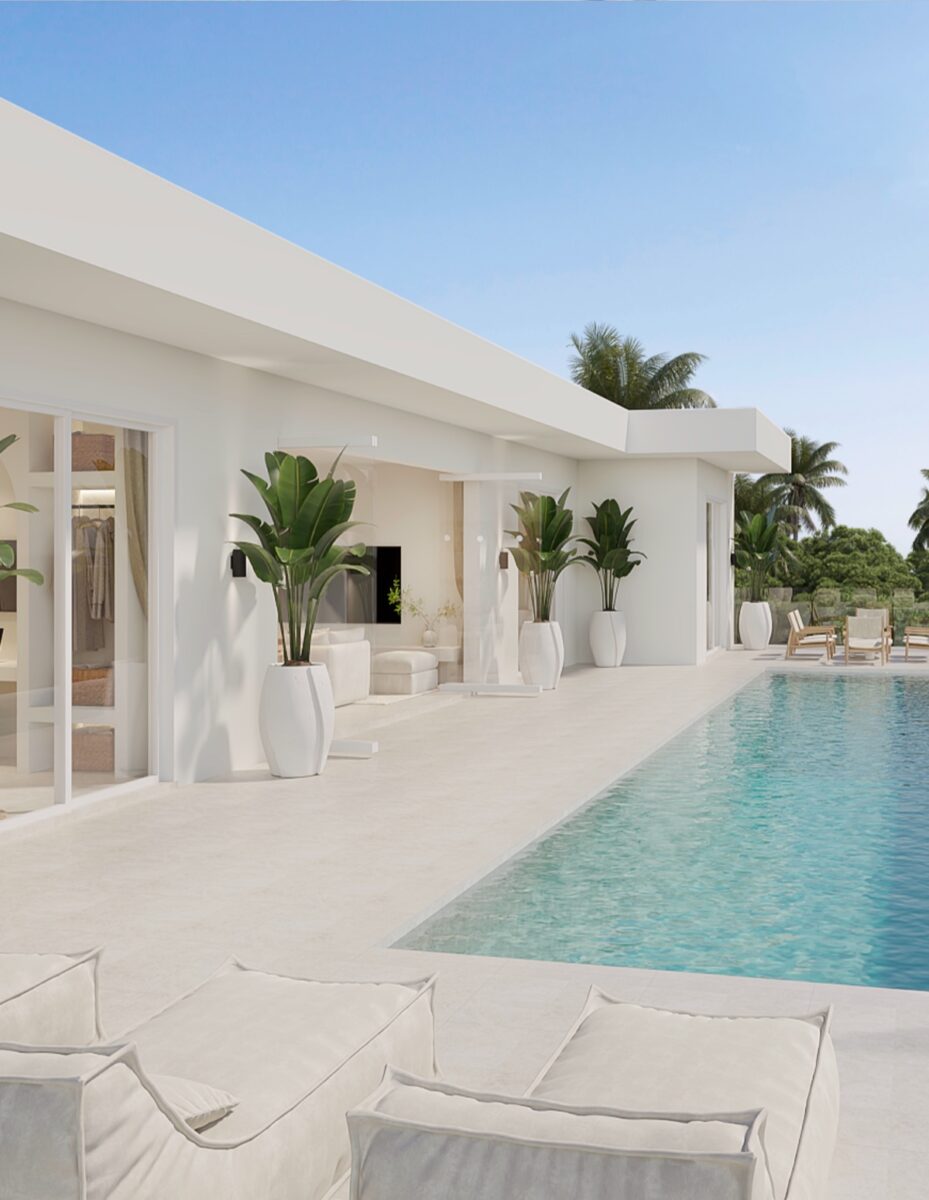
Panoramic hillside villas in Koh Samui — contemporary luxury with ocean views.
View Development →from a Decade
in Real Estate SKHAI
10 Lessons from a Decade in Luxury Real Estate
What we’ve learned building villas across top global destinations — from due diligence to maximising rental returns.
Read the Free Guide →STAY INFORMED
Luxury living, smart investing
Curated insights on real estate investment across Phuket, Koh Samui & Bali. Direct from the developer.
Free guide sent to your inbox. No spam.