Thailand Tourism 2025-2026: What Record Numbers Mean for Villa Investors
Thailand’s Tourism in 2025-2026: What the Numbers Mean for Property Investors
Thailand welcomed 32.97 million foreign tourists in 2025, generating 1.53 trillion baht in visitor spending. While the headline figure represents a 7.2% decline from 2024’s 35.5 million peak, the composition of that demand tells a far more nuanced — and for property investors, far more encouraging — story.
The Tourism Authority of Thailand (TAT) has set 2026 targets at 36.7 million foreign arrivals and 2.78 trillion baht in total tourism revenue. More importantly, the strategy has shifted from volume to value: targeting travellers staying 14-21 days and spending 65,000-80,000 baht per trip. This is the demographic that rents luxury villas.
The 2025 Tourism Numbers in Detail
Total arrivals and revenue
Thailand’s 32.97 million visitors in 2025 placed it firmly among Asia’s top tourism destinations. While the number fell short of the pre-pandemic record of 39.9 million in 2019, revenue performance tells a different story: tourism spending has recovered more strongly than arrival numbers, suggesting higher per-visitor spend — exactly the trend that benefits villa rental operators.
Source market shifts: who is visiting Thailand now
The five largest source markets in 2025 were:
- Malaysia: 4.52 million visitors (proximity-driven, short stays)
- China: 4.47 million (significant recovery, but below 2019 levels of 10.9 million)
- India: 2.49 million (fastest-growing major market)
- Russia: 1.90 million (strong demand for long-stay villa rentals in Phuket)
- South Korea: 1.56 million (steady growth, Phuket and Samui popular)
The most significant structural shift is the surge in long-haul arrivals. Long-haul visitors — primarily from Europe, the UK, USA, and Australia — reached an all-time high of 10.8 million in 2025, an increase of 10.6% over the prior year. Growth was led by the United Kingdom and United States.
Why this matters for villa investors: Long-haul visitors stay longer, spend more, and are far more likely to book private villas over hotel rooms. A European family visiting Thailand for 2-3 weeks is the core customer for luxury villa rentals. The fact that this segment is growing while short-haul, budget-oriented travel dipped slightly is net positive for the premium property market.
Phuket and Koh Samui: destination-level performance
Phuket International Airport handled 19.7 million passengers in 2024, and throughput has continued at comparable levels into 2025. The island remains Thailand’s second-largest tourism hub after Bangkok and its undisputed leader in the luxury villa rental segment.
Koh Samui recorded 1.13 million passenger arrivals in just the first four months of 2025 — a 9% year-on-year increase. Notably, 56% of Samui’s international arrivals came from Europe (UK, Germany, France), the demographic most inclined toward villa stays and extended bookings.
How Tourism Drives Property Prices
The relationship between tourism growth and property values in Thailand is not theoretical — it is measurable and consistent. Here is how the mechanism works:
1. Rental demand pushes up yields, which pushes up prices
When tourism increases, occupancy rates and nightly rental rates rise. Higher rental income translates to higher yields, which makes villas more attractive as investments, which increases buyer demand, which pushes up property prices. This cycle has driven consistent 5-10% annual price appreciation in Phuket’s prime villa areas over the past five years.
2. Infrastructure investment follows tourism
Tourism revenue funds infrastructure improvements that increase property values. Phuket’s planned second international airport — projected to handle 12.5 million passengers annually — will open new areas of the island to development while reducing congestion in established zones. New highways, improved water treatment, international schools, and premium healthcare facilities all follow tourism investment and support property values.
3. Supply constraints amplify the effect
Both Phuket and Koh Samui are islands with finite land supply. Unlike mainland destinations where development can expand outward indefinitely, island geography creates a natural supply constraint. As demand grows, prices must rise — there is nowhere else to build. This is particularly acute in prime locations like Phuket’s west coast, where available development land is increasingly scarce.
Phuket Property Market: 2025-2026 Impact
Phuket’s villa market demonstrated remarkable strength in 2025:
- Villa launches: 1,263 new villas were launched in 2024, a 51% increase from 2023, reflecting developer confidence in sustained demand
- Transaction growth: Villa transactions increased more than 20% year-on-year
- Luxury performance: Villas priced above 90 million THB recorded a 76% cumulative sales rate — the strongest asset class
- Price appreciation: Industry analysts project continued 5-7% annual appreciation in 2026, with prime areas trending higher
- Cash-driven market: Luxury villa purchases are predominantly cash transactions, insulating the market from interest rate fluctuations and credit tightening
The median villa price in Phuket stands at approximately 70,000 THB per square metre, though prime west coast developments command significant premiums. Entry-level pool villas start from around 9.9 million THB, while premium developments in Bangtao, Layan, and Kamala typically range from 15-50 million THB.
Koh Samui Property Market: 2025-2026 Impact
Koh Samui’s property market is experiencing a particularly dynamic period:
- Investment surge: The luxury vacation home market recorded 52 projects with 597 units in H1 2025, representing 14.8 billion baht in investment value — a 63.5% increase from H2 2024
- Rental yields: Net returns of 6-8% are achievable for professionally managed properties in prime locations
- Entry prices: Pool villas from 5 million THB inland to 10-25 million THB for sea-view properties — broadly comparable to Phuket across the SKHAI portfolio
- Market evolution: Condominiums now comprise 52% of total supply (up from a villa-dominated market), with most priced at 60,000-80,000 THB per sqm
Samui’s appeal to European buyers — who constitute the majority of its visitor base — creates a natural alignment between tourism demand and rental villa performance. The island’s compact geography means most properties are within 15 minutes of beaches, restaurants, and the airport.
TAT’s 2026 Strategy: Quality Over Quantity
The Tourism Authority of Thailand’s 2026 strategy represents a deliberate shift from volume-based tourism to value-based tourism. Key targets:
- 36.7 million foreign arrivals (up from 32.97 million in 2025)
- 205 million domestic trips
- 2.78 trillion baht total tourism revenue (up 7% from 2025’s 2.6 trillion)
- Target traveller profile: 14-21 day stays, spending 65,000-80,000 baht per trip
This strategy directly benefits the luxury villa sector. Budget hotels compete on price and volume. Luxury villas compete on experience, privacy, and space — qualities that command premium pricing from longer-staying, higher-spending visitors. TAT’s focus on extending average stay length and increasing per-visitor spend is, in effect, a strategy to grow the exact market segment that rents private villas.
Risks and Considerations
An honest assessment requires acknowledging risks alongside opportunities:
- Chinese recovery uncertainty: China’s 4.47 million visitors in 2025 remain well below the 10.9 million recorded in 2019. Full recovery of this market — which historically drove significant tourism volume — remains uncertain amid China’s domestic economic challenges.
- Seasonal volatility: Thailand’s villa rental market is heavily seasonal. High season (November-April) delivers 60-70% of annual rental income. Low season occupancy can drop to 30-40% without aggressive marketing and pricing strategies.
- Supply growth: The 51% increase in villa launches in 2024 means more supply is entering the market. While demand has so far absorbed new inventory, overbuilding in specific micro-locations could pressure rental rates.
- Global economic conditions: A recession in Europe or economic downturn in key source markets would reduce both tourism demand and property investment appetite.
These risks are real but manageable — particularly for investors who choose prime locations, quality construction, and professional management. The fundamentals supporting Thailand’s tourism-driven property market remain structurally sound.
What This Means for Villa Investors in 2026
The convergence of several factors makes 2026 a compelling entry point for villa investment in Thailand:
- Tourism recovery is real but not fully priced in. Long-haul arrivals have hit all-time highs, but property prices have not yet fully reflected this demand. There is a window before the market catches up.
- TAT’s quality-over-quantity strategy benefits villas. The explicit focus on longer stays and higher spending per visitor directly supports the luxury rental market.
- Supply constraints are tightening. Prime development land in Phuket and Koh Samui is finite. Current construction cost increases and regulatory requirements are slowing the pace of new supply, which supports pricing for existing and newly completed properties.
- Interest rate environment favours real assets. With global real estate markets adjusting to higher interest rates, Thailand’s cash-driven luxury market is relatively insulated — and offers yields that compete favourably with other asset classes.
SKHAI develops luxury pool villas across Thailand’s two strongest island markets — Phuket and Koh Samui — with integrated rental management through STAYLAR. Our portfolio provides direct exposure to the tourism-property dynamic described in this article.
Explore our investment guide for a detailed introduction to villa investment across our five international destinations, or browse current developments to see what is available.
Data sources: Tourism Authority of Thailand (TAT), Knight Frank Thailand, Asia Property Awards, Bangkok Post, Nation Thailand. Last updated: February 2026.
Ready to Invest in Koh Samui?
Explore our Koh Samui developments — pricing, floor plans, and projected rental yields.
View Samui InvestmentsStay Informed
Luxury real estate insights — delivered to your inbox.
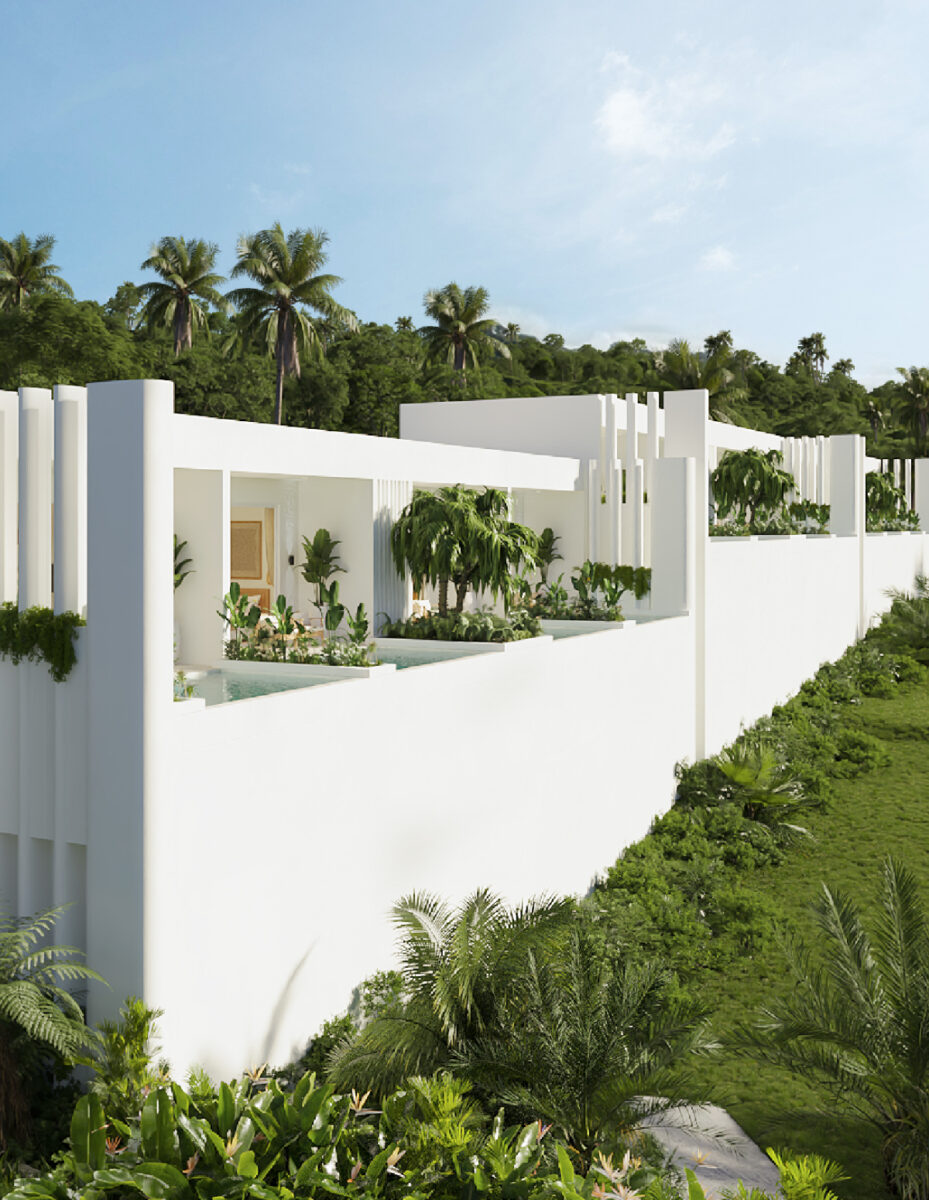
Sunrise Suites Koh Samui
Boutique suites on Koh Samui — designed for premium hospitality investment.
View Development →from a Decade
in Real Estate SKHAI
10 Lessons from a Decade in Luxury Real Estate
What we’ve learned building villas across top global destinations — from due diligence to maximising rental returns.
Download Free Guide →